
Three Belgian Cases Raise Questions About Intensive Care
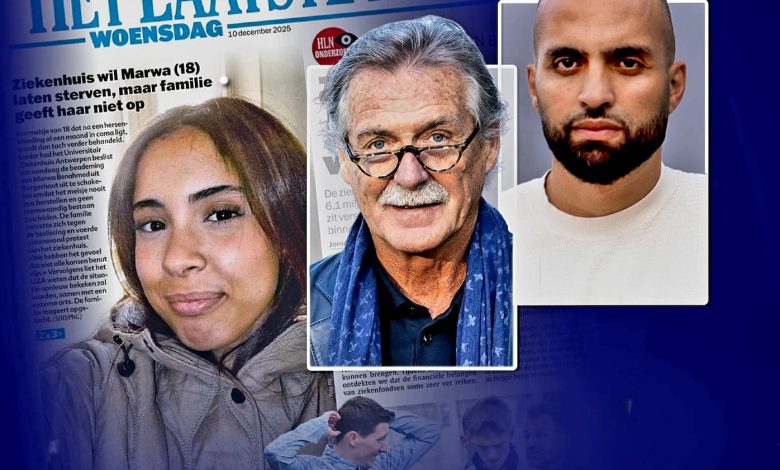
Three recent cases in Belgium have opened a difficult conversation about intensive care, end-of-life decisions, organ donation and how doctors communicate with families.
The stories of Marwa Benahmad, 18, Abdullah Zreik, 33, and Ilias Mahyou, 26, have received particular attention in Antwerp, including within the Muslim community. Their cases have also raised questions that go far beyond one community: When should doctors decide that further treatment is no longer useful? How should families be involved? And what happens when relatives are not ready to say goodbye?
Belgium Brief discussed these questions with Prof. Dr. Wim Distelmans of VUB and Antwerp funeral director Hamza Mdaouchi.
What happened to Abdullah Zreik?
Abdullah Zreik was 33 years old and worked as a forklift driver in the Port of Antwerp. On August 31, 2026, he left home for work after speaking with his fiancée. According to his family, he called her that morning and told her he was going to the port.
About an hour later, Abdullah was found unconscious at his workplace. He was taken to ZNA Middelheim in Antwerp, where he later died. The public prosecutor’s investigation found no indication of foul play.
But for Abdullah’s family, many questions remained unanswered. His relatives were particularly troubled by the decision to switch off medical equipment. They questioned why this happened while family members were still on their way to the hospital to say goodbye. Abdullah was reportedly due to get married only two weeks later.
His family and friends later held a protest outside ZNA Middelheim, carrying messages such as “Why were the machines switched off so quickly?” They said they wanted a thorough medical review and hired a lawyer to help them obtain answers.
The case does not establish that the doctors made a medical error. Instead, it highlights the emotional gap that can exist between a medical decision and the way a family experiences that decision.
For relatives, the difference between “there is no realistic chance of recovery” and “we are losing our loved one” can be enormous.
Marwa’s unexpected recovery
Marwa Benahmad was only 18 when she suffered a severe brain hemorrhage at school. Her condition became critical, and doctors initially believed that the damage to her brain was extremely serious and that meaningful recovery was unlikely.
Her family was eventually confronted with discussions about stopping treatment. But during a visit to say goodbye, relatives noticed signs that gave them hope. Further medical assessment later confirmed that her condition had unexpectedly improved.
By March 2026, her family said Marwa could read and write and was fully present again. Her story shows why severe brain injuries can be extremely difficult to assess and why communication with relatives is so important when decisions about continuing treatment are being considered.
It also shows why an unexpected medical development can have a profound effect on a family that had already been preparing for death.
Ilias and the search for a donor
Ilias Mahyou was 26 and had been dealing with severe liver disease for years. He underwent several procedures and liver transplants. His most recent transplant, in May 2026, failed when his body rejected the donor liver.
By the end of August, his condition had become critical. His family launched a public appeal for another donor liver, hoping that another transplant could save his life. But Ilias died at UZ Gent on September 2, 2026, at the age of 26.
His family later said they hoped his story would encourage more people to think about organ donation. His death also brought the issue of organ donation into the wider discussion.
Does organ donation affect treatment decisions?
One of the questions raised by these stories is whether the possibility of organ donation could ever influence a doctor’s decision to stop treatment. That is a particularly sensitive issue for families.
Medical decisions about continuing or stopping treatment should be based on the patient’s medical condition and prospects, not on whether the patient could become an organ donor.
For families who are already struggling to understand what is happening in an intensive-care unit, even the suspicion of a connection between the two can create deep mistrust.
That is why clear communication and a transparent medical process are so important.
Why communication matters so much?
Prof. Dr. Wim Distelmans and funeral director Hamza Mdaouchi also point to an important difference between the medical and emotional sides of death.
Doctors may explain a situation in medical terms, but families experience the same situation through grief, fear and hope. A sentence from a doctor can stay with a family for years.
This can be especially difficult when relatives come from cultural or religious backgrounds where death, organ donation and the withdrawal of treatment may be discussed differently.
The questions raised by these three Belgian cases are therefore not limited to the Muslim community.
They concern anyone who suddenly finds themselves sitting beside a loved one in intensive care, trying to understand whether there is still hope or whether it is time to say goodbye.
What families can ask doctors?
When a loved one is critically ill, families can ask doctors to explain clearly:
- What is the patient’s exact medical condition?
- What are the realistic chances of recovery?
- Has the patient’s condition changed since the previous assessment?
- What treatments are still being provided?
- Why is a particular treatment being continued or stopped?
- Can another specialist provide a second opinion?
- What does the medical team expect in the coming days?
These questions cannot guarantee a particular outcome, but they can help families understand the medical situation and take part in difficult decisions.
The stories of Marwa, Abdullah and Ilias show three very different situations. Together, they have sparked a wider conversation in Belgium about intensive care, communication, end-of-life decisions and organ donation.